
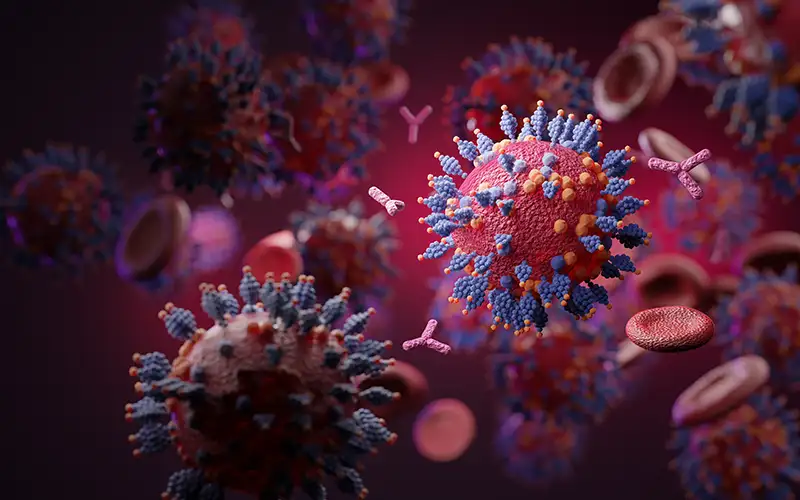
The United States is preparing for the 2026-2027 respiratory virus season. A recent report from the Centers for Disease Control and Prevention (CDC) detailed the global spread of Covid-19 variant BA.3.2. The BA.3.2 is nicknamed Cicada, due to its pattern of disappearing and reemerging. It is a highly divergent variant first identified in South Africa in November 2024. By February 2026, this variant had been detected in 23 countries and was increasingly identified in US wastewater and clinical samples.
For Kohll’s pharmacists, these findings underscore the necessity of staying informed about genomic shifts that could impact vaccine-conferred immunity and patient counseling strategies.
Cicada is characterized by approximately 70 to 75 substitutions and deletions in the spike protein relative to the antigens used in the 2025-2026 vaccines. This significant genetic distance is larger than the divergence observed between previous major strains, such as JN.1 and XBB.1.5.
Laboratory studies indicate that Cicada demonstrates enhanced in vitro immune escape, with reduced neutralization from human serum antibodies induced by currently available vaccines. This degree of mutation initially raised concerns about a potential surge in cases similar to the arrival of the original Omicron variant.
However, the Cicada lineage has not yet become the dominant strain in the United States, representing only about 0.19% of sequences in early 2026. Researchers have found that although the variant is adept at evading antibodies, it may have a constrained ability to spread rapidly because of reduced lung cell entry and angiotensin-converting enzyme 2 binding compared to other circulating variants. This biological trade-off has led to a situation where Cicada cocirculates with other JN.1 descendant lineage rather than rapidly replacing it, though experts warn that further compensatory mutations could eventually restore its infectivity.
In response to these shifting viral dynamics, the FDA vaccine advisory committee recently voted 8-0 with 1 abstention to recommend a monovalent XFG-targeted vaccine for the 2026-2027 season. Although the committee discussed the threat posed by BA.3.2, members ultimately favored the XFG strain because it is the most common variant currently in the United States. Manufacturers including Moderna, Pfizer, and Sanofi presented data showing that although XFG-targeted vaccines provide high levels of neutralizing antibodies against the JN.1 family, they offer more limited protection against Cicada (BA.3.2). This decision highlights the difficult balance regulators must strike when selecting a strain months before the peak of the winter surge.
For Kohll’s pharmacists managing vaccine inventory and patient questions, the effectiveness of the most recent 2025-2026 formulations remain a central topic. Interim data from the CDC’s VISION system showed that the previous season’s vaccine was approximately 49% effective against emergency department visits and 58% effective against hospitalizations through 6 months post-vaccination.4 These figures became a point of contention recently when reports surfaced that CDC leadership had initially blocked the publication of this efficacy data due to methodological concerns raised by administration officials, according to the Washington Post.
Despite these political complications, the data confirm that vaccination continues to provide substantial added protection even in a population with high levels of existing infection-induced immunity.
Pediatric considerations are also coming to the forefront as some data suggest Cicada may be more prevalent in children than adults. Although it is unclear whether children are truly more susceptible, preliminary reports indicate a higher percentage of pediatric COVID-19 cases are linked to this variant, which could be due to lower overall immunity in younger age groups.
Kohll’s Pharmacists are prepared to counsel parents that while Cicada Covid 19 symptoms remain similar to a standard cold—including fever, cough, and congestion, staying up to date on vaccinations remains the primary tool for preventing severe disease and hospitalization.
The role of Kohll’s pharmacists in public health surveillance will likely grow as clinical sequencing submissions decline. Wastewater monitoring has increasingly served as an effective early warning system, often detecting variants like BA.3.2 weeks before they appear in clinical specimens.
As the 2026-2027 season approaches, the integration of genomic surveillance with real-world vaccine effectiveness data will be vital for guiding clinical decisions and maintaining public trust in immunization programs. Ongoing vigilance is required to monitor whether Cicada (BA.3.2) or other emerging lineages will eventually acquire the mutations necessary to overcome current biological constraints and drive new waves of infection.
Learn more about all of the vaccines offered at Kohll’s Rx or book an appointment today at one of our five convenient locations.